By Adrián Pérez Solla
For years, the heat pump industries in Europe and North America have been largely shaped by European, Japanese, and US manufacturers. However, as with many other industries, the landscape has been shifting for some time, and the Asian giant is beginning to play an increasingly important role. China is no longer simply a place where components are manufactured; Chinese companies are increasingly becoming technology developers, equipment manufacturers, exporters, and global brands
The volume is already there
According to IEA data, China is currently the world’s leading manufacturer of both heat pumps and key components. The figures indicate that as early as 2023,that is, three years ago,40% of the heat pumps sold were manufactured in China.
When you add to this the fact that China has developed an end-to-end industry—encompassing key components such as compressors, electronics, heat exchangers, and fans—and achieved manufacturing costs far lower than those of its Asian neighbors (and especially low compared to European manufacturers), the answer is clear, China has the tools to compete globally.
From original equipment manufacturers (OEMs) to the most recognized brands
It is worth noting that while China was already a major player in the sector in 2023, its presence, particularly in Europe was relatively low-key. Much of its manufacturing capacity operated behind the scenes, supplying products under the OEM model for brands that were far better known in these countries.
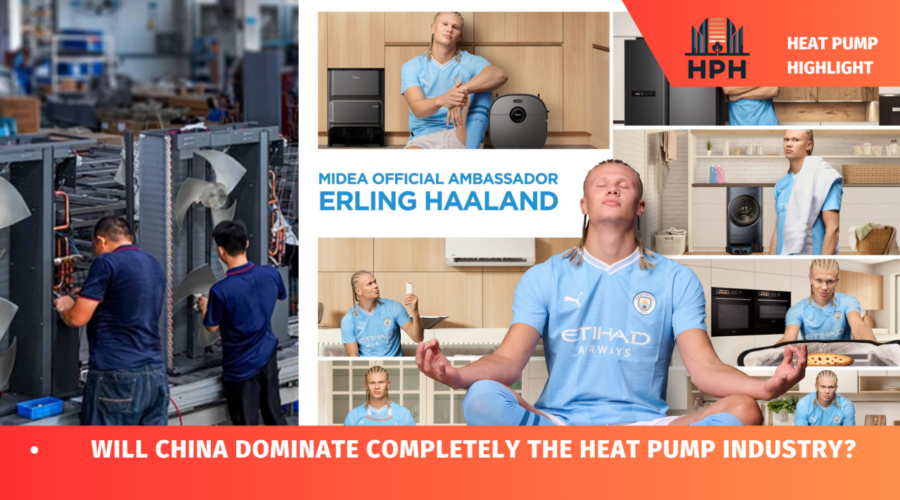
However, this is changing rapidly. Chinese brands are becoming increasingly visible and are building recognition well beyond the traditional perception of being simply low-cost manufacturers. Midea, Haier, Hisense and Gree are now established names in the HVAC and heat pump industry, while their growing presence extends well beyond it. Strategic sports partnerships are also helping to raise their profile globally, from Midea’s partnership with Erling Haaland to Hisense’s collaborations with Real Madrid and UEFA.
Midea, for example, is already translating its manufacturing scale into strong demand in Europe. During the 2026 summer heatwave, sales of its European-designed PortaSplit air-conditioning system surged, with the company reporting more than 200,000 units sold in Europe during the first half of 2026, roughly twice the figure recorded a year earlier.
Haier is following a similar path in the heat pump sector. In July, the European Heat Pump Association (EHPA) visited Haier’s headquarters in Qingdao to learn more about its heat pump R&D capabilities and product portfolio.
The European reaction
As is happening in other industries, Europe aims to step up its game in this sector; the European Commission, in particular, is working to accelerate clean-tech manufacturing, including heat pumps.
Nevertheless, China’s dominance,spanning both raw materials and components,is immense, making it extremely difficult to break free from this cycle.
In any case, European and Japanese manufacturers still maintain a significant market presence, meaning China is not the only key player.
What, then, is my vision?
I believe China’s dominance over the supply chain is very difficult to reverse; therefore, it makes more sense to target niche sectors and applications where competition is easier. As they have done in other sectors, China has moved beyond simply being the low-cost option, launching sophisticated products tailored to specific markets.
Consequently, I am inclined to think that heat pumps could follow the same path as photovoltaics, with China becoming the absolute dominant player.