By Adrián Pérez Solla
In recent weeks, I have frequently discussed the F-gas transition and how it has once again put the heat pump industry and its supply chain under pressure. This is because, for years, the heat pump industry has focused on a single question: which refrigerant should we use next?
R22, R407C, R410A then R32 and now with R290 based on regulations and enviromental requirements in continuous evolution. But, what happens if the next step would be without refrigerants?
A route under development
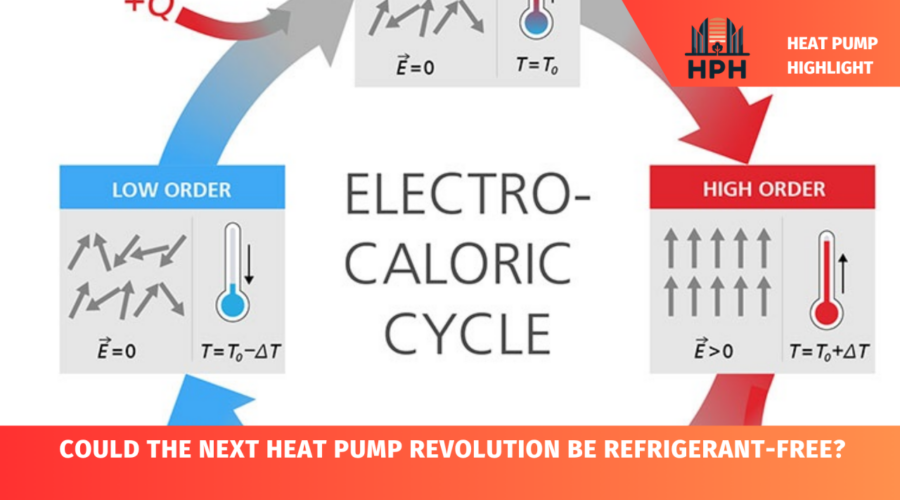
The other day, I came across a news report stating that researchers at the Hong Kong University of Science and Technology have developed an elastocaloric cooling system that uses a solid material instead of a conventional refrigerant. When the material is subjected to mechanical stress, its temperature changes, allowing for heat transfer without relying on the traditional vapor-compression cycle.
The reported results are already impressive: around 400 W of cooling capacity, a 41 K temperature span and more than one million cycles without degradation.
Another technology that hits closer to home for me
As you probably know, BlueHeart Energy and Ecoforest are already working on another possible route: thermoacoustic heat pumps.
Instead of using a conventional refrigerant cycle, the BlueHeart engine uses sound waves inside a sealed helium circuit to move heat. There is no HFC or flammable refrigerant, and the technology replaces the traditional compressor, evaporator and condenser circuit.
For Ecoforest, this is particularly interesting because it takes the question one step further. We are not simply looking for a new refrigerant with a lower GWP. We are exploring what a heat pump could look like without a conventional refrigerant at all.
The technology is still under development, and there is still a long way to go before it can compete with today’s vapor-compression systems at scale. But the first units are expected to reach the market in 2027, and Ecoforest is involved in bringing the technology to the residential market.
First steps, long future
These are only the first steps, and I am sure I am overlooking many other examples of entrepreneurs and researchers trying to rethink the fundamentals of heat pump technology and thermodynamics.
During the Industrial Revolution, who could have imagined that trains and cars would eventually operate without coal?
Heat pumps may be facing a similar moment. Today, the idea of a system operating without a conventional refrigerant may sound unrealistic. But as the industry looks for more environmentally friendly and non-flammable solutions, these technologies could eventually address both challenges at the same time.
Maybe the next revolution in heat pumps will not be about finding a better refrigerant.
Maybe it will be about not needing one at all.